Chapter 2
Mont-Blanc Carries a Cargo of Explosives
The checker at the Brooklyn loading pier marked his ledger in the grey morning of late November, his pencil moving down columns of ruled paper. Picric acid: one thousand nine hundred barrels, gross weight forty-seven thousand five hundred pounds. He counted the wooden staves bound with iron hoops, each barrel stencilled with the hazard diamond and the shipper’s mark. The numbers entered his book and became real. Where the first chapter described the rules, this one places a vessel inside them.
The ship was the SS Mont-Blanc, a steel-hulled tramp steamer built in 1899 at Middlesbrough, England, for a French shipping company registered at Saint-Nazaire. She measured three thousand one hundred twenty-one gross tons, carried a single screw, and made barely ten knots in calm water. In November 1917 she was chartered to the French government to carry a complete cargo of military explosives from New York to Bordeaux. Her master was Aimé Le Medec, a Breton captain who held the required certificates for carrying dangerous goods and had commanded vessels through the wartime convoy system before. The charter party specified that she would sail under the protection of the Allied navies, joining a slow convoy gathering at Halifax where ice-free waters offered the only winter passage to Europe.
The checker continued down the manifest. Trinitrotoluene: two hundred tons in hundred-pound cases. Guncotton: ten tons packed in wet felt. Benzol: forty barrels of the volatile coal-tar distillate stacked on deck as fuel for the boilers and ballast for the trim. Each entry carried a classification number under the International Maritime Dangerous Goods code. A separate insurance rider accompanied every line. The port authorities required notification seventy-two hours before arrival. The danger was declared, quantified, and accepted before she ever entered the channel.
The barrels descended into her holds on steam winches. The picric acid, yellow crystalline and notoriously sensitive, packed in metal tins inside the wooden barrels, filled the forward compartment to within six inches of the deckhead beams. The TNT cases, more stable but heavier, went aft, stacked in pyramids that channeled any potential blast upward through the hatches. The benzol drums sat lashed on the afterdeck under tarpaulins, breathing vapour that condensed in the cold November air. Stevedores wore felt-soled shoes; the winchmen checked their brake shoes for sparks; the hatch covers were secured with copper nails rather than steel to prevent striking fire. These were not precautions born of imagination. They were the prescribed methods for handling Class A explosives under the regulations of the United States Shipping Board and the corresponding French Ministry of Marine instructions.
She sailed from New York on November 30, 1917, her papers complete. The manifest travelled in triplicate: one copy sealed in the captain’s strongbox, one forwarded by courier to the French consul at Halifax, one transmitted by telegraph to the Admiralty convoy office. The Mont-Blanc carried no passengers, no mail, no general cargo to complicate her stowage. Her value lay entirely in the chemistry packed below her waterline and stacked above it. She was a floating magazine, lawful and licensed, expected at her destination.
The voyage up the coast took five days. She kept close to shore, steaming blacked out against submarine attack, her running lights extinguished, her wireless silent except for scheduled position reports in code. Le Medec maintained the watch schedule required for a vessel carrying explosives: double lookouts, no smoking on deck after dark, galley fires damped at night and relit only at dawn under supervision. The crew of forty-one men understood the nature of their cargo; they slept in their clothes and kept their life jackets within reach of their bunks. In wartime, thousands of such vessels crossed the Atlantic, and the routine of danger had become ordinary.
Late on the afternoon of December 5, she raised the Chebucto Head light and turned into the approaches to Halifax Harbour. The pilot boat met her outside the anti-submarine nets. Francis Mackey, an experienced harbour pilot licensed by the Nova Scotia Pilotage Commission, came aboard at 5:00 p.m. He carried the local charts and the authority to navigate the inner channels. As he climbed the pilot ladder, he asked Le Medec about “special protection,” the protocol reserved for munitions vessels. The captain showed him the manifest. Mackey noted the quantity of high explosives and requested that the ship be berthed in Bedford Basin, away from the crowded piers of Halifax proper. Le Medec agreed. They steamed slowly past Georges Island, where the examination anchorage lay, and waited for the naval signal to proceed.
The harbour master’s launch came alongside at 7:15 p.m. The assistant harbour master recorded the arrival in the daybook: SS Mont-Blanc, French, 3121 tons, Master Le Medec, cargo explosives, bound for Bordeaux via convoy. The entry was routine. The logbook made no distinction between the Mont-Blanc and the coal freighter that had entered an hour earlier, or the Norwegian relief ship Imo waiting at anchor. The clerk initialled the pilot’s request for a berth in the Basin and assigned her to a mooring near the eastern shore, clear of the main shipping lane. The paperwork was complete. Everyone who needed to know what she carried did know.
Inside the defences, the Mont-Blanc was subject to the King’s Regulations and Admiralty Instructions governing the movement of explosives in a naval port. She must fly a red flag by day and exhibit a red light by night. She must maintain a fire patrol on deck. She must not move within the harbour except during daylight hours and only with a pilot aboard. She must anchor no closer than two hundred yards to any other vessel. She must wait for the convoy commodore’s signal before attempting the Narrows, the five-mile channel that connected Bedford Basin to the outer harbour and the sea.
Mackey guided her to her assigned berth in the dark. The anchor chains rumbled out through the hawse pipes and bit into the mud of the Basin. The red light went up on the foremast. The engines stopped. Below decks, the cargo sat in its wooden barrels and metal tins, chemically stable at the low temperature but inherently unstable by nature. The benzol drums on deck ticked as they contracted in the cold. The ship was still.
Morning on December 6 broke clear and cold. The Mont-Blanc lay at anchor in Bedford Basin, her papers in order, her crew at breakfast, her pilot waiting for the signal to proceed downstream. The convoy assembly signal had not yet come; she was scheduled to move later that morning, when the tide served and the escort vessels were ready. She was a known and scheduled hazard, positioned according to all proper procedures in the narrow waterway.
The manifest that Mackey examined was not a single sheet but a folio of interlocking documents, each cross-referenced to the others. The French Ministry of Armaments had issued the original requisition order in Paris on November 12, directing the New York purchasing commission to assemble the cargo. The order specified grades and quantities: picric acid of military specification, not less than 95 percent pure; TNT cast in blocks suitable for shell loading; guncotton of the wet variety, stabilized with alcohol to prevent the desiccation that made it sensitive to shock. Each manufacturer—E.I. du Pont de Nemours for the TNT, the Hercules Powder Company for a portion of the guncotton, the Barrett Company for the picric acid—had submitted certificates of analysis with their invoices. These certificates travelled with the manifest, proof that the chemistry met the standards of the French army’s artillery service.
The benzol represented a different category of hazard. Unlike the explosives, which required initiation to detonate, benzol was a simple flammable liquid, its vapours forming explosive mixtures with air at concentrations between 1.4 and 8 percent. The forty barrels on deck contained roughly eight thousand gallons, enough to saturate the atmosphere above the ship with combustible gas if the seals failed. The barrels were of oak, hooped with iron, painted red with the word INFLAMMABLE stencilled in white. They sat on wooden skids lashed to the deck with manila rope, not chain, to prevent sparking. The placement was deliberate: deck cargo could be jettisoned in emergency, and the vapours would dissipate in the open air rather than accumulate in a hold. Yet the arrangement also meant that any fire on deck would find immediate fuel, and that fuel would find the explosives below.
The Mont-Blanc’s registry documents told their own story of wartime adaptation. Built as a general cargo carrier, she had been requisitioned by the French government in 1915, released, then requisitioned again in 1917 when the need for explosives transport exceeded the capacity of purpose-built naval auxiliaries. Her classification by Bureau Veritas, the French maritime society, had been amended to include “Transport de matières explosives—Classe A” only after inspection of her bulkheads, her ventilation system, her electrical installations. The certificate noted that her holds were fitted with copper screens over the ventilators to prevent the entry of sparks, that her lighting circuits were isolated from the main power plant, that her cargo booms were fitted with sheaves of lignum vitae rather than metal bearings. These modifications had been made in Saint-Nazaire during the summer of 1917, documented in a survey report that accompanied her papers.
The loading at Brooklyn had proceeded under the supervision of a United States Shipping Board inspector named Harold Walker, whose initials appeared in the margin of the manifest at each stage of completion. Walker had served in the merchant marine before the war and understood the difference between theoretical regulations and practical stowage.
He had insisted that the picric acid barrels be “broken stowage”—separated by dunnage, wooden battens that would prevent the barrels from shifting in a seaway and abrading their metal linings. Picric acid was particularly dangerous when it formed metal picrates, compounds created by reaction with the iron or zinc of containers, which could detonate from friction. The wooden battens added weight and consumed space; Walker accepted the reduction in total cargo quantity as the price of safe carriage.
His inspection report, filed with the Shipping Board and copied to the French consulate, noted that the Mont-Blanc’s cargo was “stowed in accordance with best practice for high explosives, all precautions observed, vessel fit for ocean passage.”
The financial architecture surrounding the cargo was equally intricate. The French government had secured the Mont-Blanc through a time charter, paying a daily rate for the vessel plus a “danger money” premium for the explosive cargo. The cargo itself was insured through Lloyd’s of London under a policy that specifically excluded “war risks”—the perils of submarine attack, mining, or hostile aircraft—while covering “marine risks” including collision, stranding, and fire. The underwriters had required, and received, copies of the manifest and the stowage plan before binding coverage. The premium was calculated at four percent of cargo value, roughly ten times the rate for ordinary merchandise. This insurance arrangement meant that a community of London merchants and brokers had examined the Mont-Blanc’s papers, quantified her hazard, and priced the risk of her passage. The market had spoken: she was dangerous but manageable, a calculated wager rather than an unacceptable uncertainty.
The harbour of Halifax in December 1917 operated under a system of controlled congestion. The port had been selected as the North American terminus for the Atlantic convoy system partly because its geography permitted this control: the anti-submarine nets at the harbour mouth, the examination anchorage at Georges Island, the spacious Bedford Basin beyond, all allowed the Royal Canadian Navy and the Royal Navy to sequence arrivals and departures according to operational need rather than commercial pressure. The Mont-Blanc entered this system as a scheduled element, her arrival telegraphed from New York three days in advance, her expected time of passage through the nets calculated to the hour.
The naval control room at Wellington Barracks maintained the master schedule. Lieutenant-Commander Frederick Wyatt, the senior naval officer in Halifax, had approved the Mont-Blanc’s assignment to Bedford Basin on the evening of December 5, based on the pilot’s recommendation and the harbour master’s availability of berths. The decision was recorded in the naval daybook without comment: “French steamer Mont-Blanc, explosives, to anchor Basin E-4, await convoy HX-7.” The notation “explosives” appeared in the column reserved for cargo description, alongside “coal,” “general,” and “in ballast” for other vessels. The system was designed to accommodate dangerous cargo, not to highlight it. The very ordinariness of the entry was the point: the Mont-Blanc was a routine assignment within a routine that had handled hundreds of similar vessels since the convoy system began in 1917.
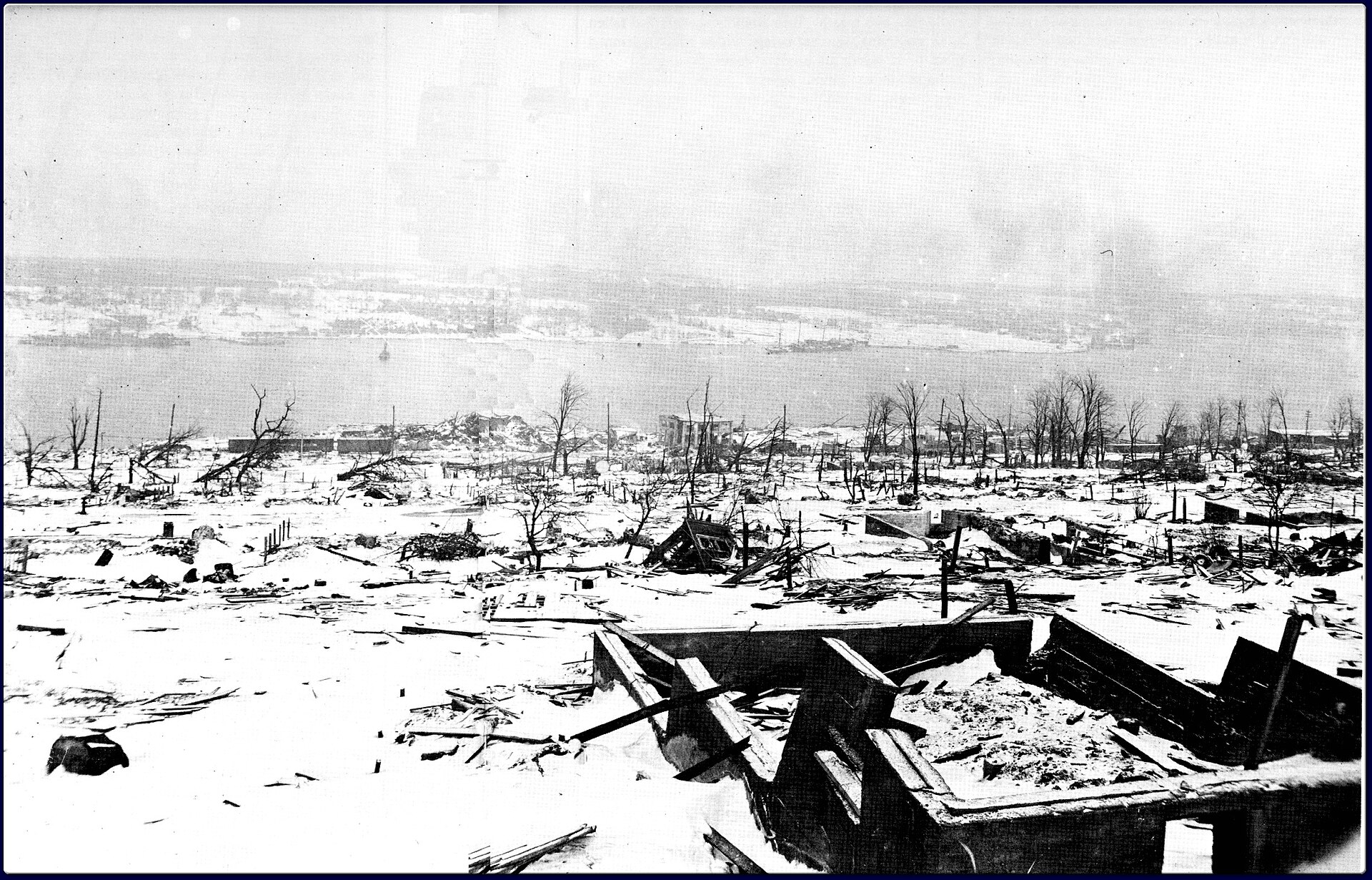
Yet the physical reality of her presence introduced specific constraints into the harbour’s operation. The King’s Regulations specified that no vessel carrying explosives might be approached by steam-powered craft except under signal, to prevent the injection of sparks from funnels. The Mont-Blanc’s berth in Bedford Basin was therefore isolated by protocol as well as distance: the water around her was technically a restricted zone, though the restriction was enforced by custom and notice rather than physical barrier. Small boats—sailing craft, rowboats, the harbour master’s launch under oars—might approach for official business. Tugs, which would normally assist a vessel of her size to anchor, were excluded unless specifically requested by the master and approved by the naval authorities.
The crew of the Mont-Blanc occupied an ambiguous position within this system of safeguards. They were civilians under military discipline, merchant seamen carrying naval cargo, French nationals in a British port. Their quarters were forward, in the forecastle and the deckhouse, separated from the cargo holds by the engine room and the boiler space. They ate at mess tables bolted to the deck, cooked in a galley with a coal range that was extinguished at night, slept in hammocks and bunks that would become lethal projectiles in any explosion.
Captain Le Medec had addressed them on the morning of departure from New York, reading the regulations aloud in French and broken English: no smoking except on the open deck, no matches in pockets, no metal tools without permission, life jackets always within reach. The men had heard such instructions before. Some had sailed with explosives previously; others were new to the Mont-Blanc, recruited from the waterfront boarding houses of Brooklyn to replace crewmen lost to the draft or better-paying ships.
They had signed the articles knowing the cargo, accepting the danger money that doubled their ordinary wages.
The interval between the Mont-Blanc’s anchoring on the evening of December 5 and her scheduled movement on the morning of December 6 was a period of suspended operation. The crew performed maintenance: greasing the winches, checking the lashings on the benzol barrels, pumping bilges to keep the holds dry and cold. Le Medec and Mackey discussed the passage through the Narrows, studying the tide tables and the convoy sailing orders that had not yet arrived. The pilot remained aboard, sleeping in the chartroom, his presence required by regulations for any movement of a munitions vessel. The ship was fully staffed, fully prepared, and fully immobilized by the absence of a signal.
This suspension was the characteristic condition of Halifax in wartime: a port of waiting. The Basin held dozens of vessels in similar suspension, their crews eating, sleeping, maintaining, while the naval authorities determined the sequence of departure. The coal colliers waited for the Admiralty’s estimate of European consumption. The troopships waited for the infantry battalions to complete their training. The relief vessels waited for the diplomatic clearances that would protect them from submarine attack. The Mont-Blanc waited for the convoy commodore’s signal, which would coordinate her movement with that of the escorting destroyers and the other merchantmen of HX-7. The rules that governed her were designed for this waiting: to keep her safe while stationary, to control her movement when it came, to integrate her hazard into the larger hazard of wartime shipping.
The documentation of her presence accumulated through the night. The harbour master’s clerk made his rounds at 10:00 p.m., noting in the patrol book that the Mont-Blanc showed proper lights, that her anchor watch was posted, that no irregularities were observed. The naval signal station at York Redoubt logged her position at midnight, part of the harbour-wide inventory of anchored shipping. The French consul in Halifax, informed of her arrival by the couriered manifest, filed his own report to Paris, estimating the date of her departure and her expected arrival in Bordeaux. Each of these entries was a thread in the web of accountability that surrounded the vessel: proof that she had been seen, recognized, and recorded, that her location was known and her status understood.
The cold intensified after midnight, the temperature falling below freezing and forming a skin of ice on the freshwater streams that entered the Basin. The Mont-Blanc rose slightly on the tide, her anchor chain shortening as the water deepened, then settled again as the ebb began. The benzol drums contracted further, their staves creaking, the iron hoops adjusting to the reduced circumference. Below decks, the picric acid crystals sat in their metal tins, chemically inert at these temperatures, requiring the heat of a fire or the shock of detonation to release their energy.
At Pier 6, downstream in the Narrows, a Norwegian steamer cast off her lines. She was the Imo, chartered to the Belgian Relief Commission to take humanitarian supplies to German-occupied Belgium, light in ballast and anxious to depart against the inbound tide. Her master had obtained clearance from the harbour master’s office an hour earlier. She swung her bow into the channel and began to move upstream, toward the Basin, toward the anchored Mont-Blanc, toward the narrowest point of the channel where two vessels could not pass abreast. The rules had brought them both there, to the same water at the same hour, one laden with declared explosives and the other moving under orders of urgent departure.
Mont-Blanc, a known and scheduled hazard, is now in position, while another vessel prepares to depart on a collision course through the same narrow channel.