Chapter 15
The Last Order:South Georgia or Nothing
They felt the weight of the months ahead, the darkness coming, the cold intensifying—the same weight that had settled over twenty-two men in a stone hut on a beach in Antarctica, waiting for a boat that might never return. But on the morning of 24 April 1916, that weight settled unevenly across twenty-eight pairs of shoulders. For twenty-two men, the burden meant waiting on a stony shore where the wind cut through stone walls and penguins would have to keep coming—waiting through a winter that would last until someone returned or until hope itself froze solid. For six men, the burden meant something else entirely: a boat, a bearing, and an ocean that had never been crossed in an open craft.
Frank Worsley pressed his eye to the sextant for the final time before departure. The instrument was their one uncorrupted connection to the mathematics of rescue. His hands moved with the deliberate care of a man handling probability itself. The latitude he calculated now would be their starting point, the first mark on a chart that extended eight hundred miles across the Southern Ocean to South Georgia. If his calculations were wrong, the boat would miss the island. If the boat missed the island, there was nothing else.
The James Caird measured twenty-two feet from stem to stern—a lifeboat designed to carry men from a sinking ship to safety, not to carry six men across the most dangerous ocean on Earth. A man could walk her length in seven paces; the distance they intended to cover would take weeks.
Harry McNish worked at the keel with tools he had improvised from wreckage. He had already transformed the James Caird once, raising her sides with canvas and wood to give her some chance against the waves that would sweep the Southern Ocean. Now he checked every seam, every fastening. McNish was sixty years old, the oldest man in the expedition, and his hands knew things about boats that no younger man could learn. He had clashed with Shackleton on the ice—the Boss had not forgotten the carpenter’s insubordination, the moment when McNish had questioned whether the ship’s articles still bound them after the ship itself was gone. But Shackleton had chosen him anyway. The carpenter’s value outweighed his history. As the sources note, while not forgetting his earlier insubordination, Shackleton recognised McNish’s value for this particular job.
Tom Crean hauled stores toward the waterline. He had “begged to go,” according to those who heard him. Crean did not volunteer for glory or for duty alone; he volunteered because going was what he did. He had been with Scott on the Discovery expedition, with Scott again on Terra Nova, and now with Shackleton on Endurance. The thirty-seven-year-old Irishman carried his silence like a tool. When Shackleton needed someone to stand at the oar for hours without complaint, to take the worst watch, to do the work that had to be done without being asked twice, Crean was the choice.
Timothy McCarthy and John Vincent loaded the final provisions. McCarthy, the youngest at twenty-five, had proven himself during the boat journey from the ice to Elephant Island—steady at the oar, steady in a crisis. Vincent, the boatswain, brought raw physical strength and an ability to endure hardship that had impressed Shackleton during the worst days on the floes. Both men understood what they were boarding. The Southern Ocean in winter. A twenty-two-foot boat. No radio, no escort, no margin for error.
Shackleton stood apart from the preparations, watching. He had made his calculations already, weighed his probabilities, chosen his crew. The Boss carried the weight of decision in his posture, in the set of his shoulders, in the way his eyes moved across the beach taking inventory of what was being left behind. He had explained his reasoning to Frank Wild in private: Wild would command the twenty-two who remained. If the James Caird failed, if no rescue came by spring, Wild was to attempt to reach Deception Island in one of the remaining boats. The plan was not a good one. It was simply the only alternative to dying on Elephant Island.
The morning dawned with the kind of clarity that could deceive. The sky above Point Wild showed patches of blue between the clouds, and the wind had dropped enough to make launching possible. But the temperature sat near freezing, and the sea beyond the sheltering rocks showed whitecaps even in the relative calm. The Southern Ocean in autumn offered what passed for good weather; in any other water it would have been considered dangerous.
The men on the beach had gathered to watch. Twenty-two figures in frozen clothing, standing on a strip of shingle that measured perhaps a hundred yards in length, backed by a glacier that rose in a wall of blue ice. They had built their stone hut with their own hands, roofed it with the two remaining boats and canvas, named it the “Snuggery” with the kind of irony that kept despair at bay. Now they watched six of their number prepare to leave.
The farewells were brief. There was nothing to say that had not been said already. Shackleton had spoken to each man individually over the preceding days, explaining what he expected, what they should do if rescue did not come, how they should maintain discipline through the winter. The men who remained had accepted their role with the stoicism that had become the expedition’s default mode. They understood the mathematics: six men had a chance in the James Caird. Twenty-eight men had no chance at all.
Worsley recorded the final coordinates in his navigation book. The position of Elephant Island had been determined through observations made during their first days ashore—latitude 61° 05′ South, longitude 54° 53′ West. The position of South Georgia had been charted by earlier expeditions—latitude 54° 15′ South, longitude 36° 45′ West. The difference was roughly eight hundred miles of open ocean, across a stretch of water where the winds blew west to east without interruption, where the waves built across thousands of miles of fetch, where icebergs drifted unseen in the grey half-light of approaching winter.
The loading of the James Caird had been calculated to the last ounce. Shackleton insisted on packing only enough supplies to last for the voyage—no more, no less. Every pound of extra weight reduced their speed, increased their draft, made the boat more vulnerable to capsizing. As the sources confirm, Shackleton took supplies for only four weeks, judging that if land had not been reached within that time the boat would be lost. They carried provisions for four weeks, water in salvaged tanks, fuel for a primus stove that would heat their food and provide the only warmth they would know. They carried spare oars, a few tools, the carpenter’s caulking materials, and Worsley’s navigation instruments. They carried nothing else.
The boat sat low in the water even before they boarded. The raised sides that McNish had built would keep most of the spray out, but any serious wave would wash over the gunwales. They would bail continuously, taking turns at the pump and the bucket, for as long as the voyage lasted.
McNish finished his final inspection of the hull. The caulking held. The fastenings held. The improvised deck that would give them some shelter from the waves was secured. The carpenter stood back and nodded to Shackleton—a professional’s acknowledgment that his work was done, that the boat was as ready as skill could make it. What happened next was in other hands.
The six men boarded. Shackleton took the helm position, Worsley forward where he could take sights, Crean, McCarthy, Vincent, and McNish at the rowing benches. The arrangement put the heaviest men where their weight would stabilize the boat, the most experienced sailor where he could navigate, the leader where he could make decisions. Necessity had shaped this configuration during the boat journey from the ice; now it held again.
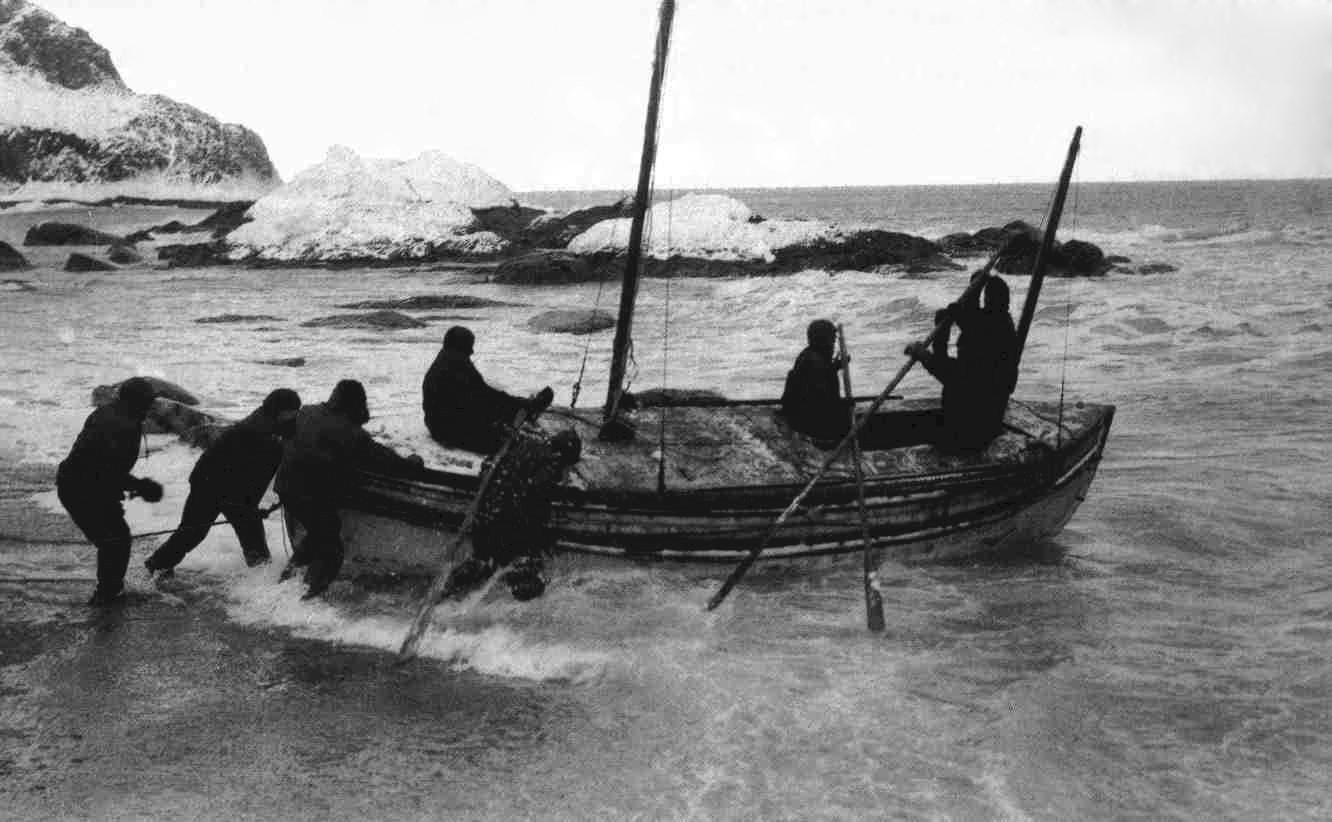
The men on the beach pushed the boat into the water. The James Caird floated free, and for a moment she sat motionless while the six adjusted their positions, found their balance, settled into the routine they would maintain for weeks. Then Shackleton gave the order to row, and the oars bit into the grey water. The James Caird was launched from Elephant Island on 24 April 1916. The wind was a moderate south-westerly, which aided a swift getaway, and the boat was quickly out of sight of the land.
The separation came quickly. The James Caird moved away from Point Wild, from the stone hut, from the twenty-two figures standing on the shingle. The men on the beach raised their arms in farewell, and some of them would later write about that moment in their diaries—the moment when rescue became a probability rather than a wish, when the Boss and five others rowed away into the emptiness and left them behind. The moment held both hope and its opposite. If the James Caird succeeded, rescue would come. If she failed, twenty-two men would spend the winter on Elephant Island with no prospect of salvation.
The boat passed the line of rocks that sheltered the beach from the open sea. The waves found them immediately, lifting the James Caird and dropping her with the rhythm of the Southern Ocean. Worsley looked back once, recording the sight of Elephant Island shrinking behind them, and then turned his attention forward. There was no point in watching what they were leaving. The only thing that mattered now was what lay ahead. Shackleton, as noted in the sources, ordered Worsley to set a course due north, instead of directly for South Georgia, to get clear of the menacing ice-fields that were beginning to form.
Shackleton had calculated his strategy with the same precision that Worsley applied to navigation. The Southern Ocean’s prevailing winds blew from west to east, driving the waves in the same direction. A boat sailing east from Elephant Island would have the wind behind it—a following sea that could push them toward South Georgia. But the same following sea that provided propulsion also threatened to broach the boat, to turn her sideways to the waves and capsize her in an instant. The helmsman would need to maintain perfect attention for every moment of the voyage. A single lapse, a single moment of inattention, and the James Caird would roll.
The alternative route—sailing north to warmer waters, seeking the shipping lanes that passed between South America and the Falklands—offered different mathematics. The distance was shorter, the waters were warmer, but the winds were variable and the chance of being seen by a passing ship was vanishingly small. The Southern Ocean was empty in 1916. Ships followed the great circle routes that took them far from the Antarctic convergence, and a twenty-two-foot boat would be invisible at anything beyond a mile. If they missed the shipping lanes, they would drift until the supplies ran out.
South Georgia offered certainty, or as close to certainty as the Southern Ocean allowed. The island was a fixed point on the chart, a whaling station on its eastern shore, supplies and shelter and men who could help. If they could reach South Georgia, they could return for the twenty-two on Elephant Island. The voyage was longer and more dangerous, but the destination was known. Shackleton had chosen South Georgia. The alternative was not really an alternative at all.
The James Caird made her first miles under oar power, clearing the lee of Elephant Island and feeling the full force of the ocean swell. The waves ran four to six feet even on a relatively calm day, and the boat rose and fell with a motion that tested the stomachs of men who had not eaten properly in weeks. McNish, despite his age and his experience, felt the nausea first. The carpenter had spent his life at sea, but the motion of a small boat in big water was different from anything a deckhand on a full-rigged ship had ever known.
By afternoon, the James Caird had cleared the immediate waters around Elephant Island. Worsley took his first sight of the sun, checking their position against his calculations. The boat was moving east-northeast, carried by wind and current toward the open ocean. The navigator recorded the observation in his book, adding the numbers to the growing record of their progress. Every mile east was a mile closer to South Georgia, a mile farther from the twenty-two men waiting on the beach.
The weather held through the first day. The six men established their routine: four hours at the oars or the helm, four hours resting, four hours on watch. The cycle would continue without break for as long as the voyage lasted. There would be no real sleep, no real rest, only intervals of exhaustion punctuated by intervals of labor. The boat was too small to lie down properly; the best they could manage was a crouching position under the improvised deck, knees drawn up, head resting against the hull.
Night came early in late April at these latitudes. The sun set around six in the evening and rose after six in the morning, leaving twelve hours of darkness that would grow longer as they sailed south. Worsley needed daylight for his sights, needed the sun or at least the horizon to fix their position. In the dark, they steered by dead reckoning—estimating their course and speed, hoping that the wind and current matched their assumptions.
The first night passed without incident, if “incident” meant capsizing or foundering. The James Caird shipped water continuously, spray washing over the gunwales and finding every gap in the canvas cover. The men bailed with buckets and with a pump that McNish had salvaged from the Endurance, taking turns at the backbreaking work. The cold was constant, the wetness was constant, the discomfort was so total that it ceased to register as a separate sensation and became simply the condition of existence.
Shackleton maintained the discipline that had held the expedition together since the ship was crushed. He checked each man’s condition, adjusted the watch schedule when someone showed signs of exhaustion, made the small decisions that kept a crew functioning. The Boss had always understood that leadership in extremis was not about inspiration but about attention—paying attention to the details that could kill, paying attention to the men who could break, paying attention to the thousand small failures that could cascade into catastrophe.
The second day brought weather. The wind freshened from the northwest, driving the waves higher and pushing the James Caird faster toward the east. The following sea that Shackleton had counted on was building, and with it came the danger of broaching. The helmsman—first Worsley, then Crean, then Vincent—had to keep the boat’s nose pointed at the waves behind them, letting swells pass beneath without turning sideways. Exhausting work demanded constant attention and constant adjustment.
Worsley managed to take a sight during a break in the clouds. The observation showed they had covered more ground than he had estimated—the wind was stronger than it felt, or the current was helping, or both. The navigator recorded the position and recalculated their bearing. South Georgia lay to the east-northeast, and they were making good time. But “good time” on the Southern Ocean was relative. They had been at sea for two days; they had perhaps three weeks of provisions; they had eight hundred miles to cover.
The math was unforgiving. Even at their best speed, the James Caird could not average more than sixty miles per day. In perfect conditions, they would reach South Georgia in two weeks. But conditions on the Southern Ocean were never perfect. Storms could drive them backward, force them to heave to and wait for the weather to pass. Icebergs could appear without warning, forcing them to alter course. The boat itself could fail—a sprung plank, a broken oar, a failed seam—and then the calculation would change entirely.
The third day brought the first serious test. The wind shifted to the southwest, blowing harder, and the waves built to heights that made the James Caird seem like a toy. A breaking wave could swamp the boat in an instant, filling her with water faster than the men could bail. Shackleton ordered the sea anchor deployed—a canvas cone that would keep the boat’s bow pointed into the waves and reduce their drift. They would not make easting while hove to, but they would stay afloat.
The men took turns at the helm, four hours on and four hours off, maintaining the discipline even when it seemed pointless. McNish, despite his age and his earlier conflicts with Shackleton, worked without complaint. The carpenter had found his role: he was the one who fixed what broke, caulked what leaked, improvised what was needed. When the pump began to fail on the third night, McNish took it apart in the darkness, found the worn part, and fashioned a replacement from a piece of spare wood. The pump worked again. The boat stayed afloat.
Crean and McCarthy handled the worst of the physical labor. The two sailors had the strength and the stamina for the oar work, the bailing, the constant movement that the voyage demanded. Crean in particular seemed tireless, taking the hardest watches without complaint, eating his reduced rations without comment, maintaining the silence that had always been his style. McCarthy was more outgoing, telling stories during the rest periods, keeping the mood from turning entirely inward. The contrast between them—the silent Irishman and the talkative young sailor—balanced the crew.
Vincent struggled. The boatswain had been strong on the ice, but the boat was different. The confinement, the wetness, the constant motion wore at him in ways that physical labor on solid ground had not. He developed sores where his clothes chafed, and the sores became infected in the damp conditions. By the fourth day, Vincent was running a fever and moving more slowly than the others. Shackleton noticed, adjusted the watch schedule, gave Vincent the easiest positions. The Boss could not afford to lose a man, even a sick one.
The weather cleared briefly on the fifth day, and Worsley took a sight that showed they had made significant easting. The wind had shifted back to the northwest, and they were moving again. South Georgia was still distant, but the distance was measurable now—a finite number of miles that decreased with each hour of sailing.
The sixth day brought ice. Growlers—small icebergs that floated low in the water—appeared in the grey light of morning, forcing the helmsman to steer constantly to avoid collision. The ice had calved from the Antarctic coast and drifted north on the currents, carried by the same forces that had carried the Endurance for ten months. Seeing ice again, after everything they had survived, was a reminder of how close they still were to the continent that had nearly killed them. Shackleton ordered the boat south, away from the ice. The detour would cost them miles, but hitting a growler at speed would cost them everything.
The seventh day was the halfway point, though none of them knew it exactly. Worsley’s calculations showed they had covered roughly four hundred miles, with perhaps four hundred more to go. The provisions were holding, the boat was holding, the men were holding. But “holding” was a relative term. They were exhausted, cold, wet, and underfed. The rations that Shackleton had calculated for four weeks would need to stretch further if the weather turned against them.
The eighth day brought the storm they had been dreading. The wind shifted to the south and increased to force nine—what sailors called a strong gale, with waves that could reach thirty feet. The James Caird was not designed for conditions like these. No open boat was. The waves lifted them up and dropped them down, and each drop threatened to break the boat apart.
Shackleton ordered the sea anchor deployed again, and they hove to, riding out the storm as best they could. The boat shipped water continuously, and the men bailed continuously, passing buckets hand over hand in the darkness. There was no sleep, no rest, only the rhythm of the bail and the pump and the desperate attention to keeping the boat afloat.
The storm lasted thirty-six hours. By the time it passed, the James Caird had been driven backward, losing miles they would need to make up. Worsley took a sight as soon as the clouds broke and confirmed what they already knew: they were farther from South Georgia than they had been two days before. The navigator did not comment on the mathematics. There was no point. The only thing to do was keep going.
The ninth day found them exhausted and low. Vincent’s fever had worsened, and McNish had developed a similar infection in his hands—the carpenter’s work in the cold and wet had taken its toll. Crean and McCarthy continued to row, continued to bail, continued to do what needed to be done. Worsley took sights whenever the weather allowed, recording their progress in the book that would be the only record if they failed.
Shackleton walked the narrow length of the boat, checking each man, adjusting each position, maintaining the discipline that had become the only thing standing between them and death. The Boss had always understood that leadership was not about morale but about structure—giving men a framework within which they could function, giving them tasks that had to be done, giving them a routine that could carry them through the worst. The routine was holding, barely, but it was holding.
The tenth day brought a shift in the wind, and the James Caird began to make easting again. The boat moved slowly, taking water with every wave, but she moved. Worsley calculated their position and found that they were within two hundred miles of South Georgia. The number sat in the air like a promise, or a threat. Two hundred miles was close enough to see, if the weather held, if the boat held, if the men held.
The eleventh day brought the first sight of the island. Not the island itself—the mountains of South Georgia were still hidden below the horizon—but the clouds that gathered above it, the distinctive formations that told a navigator that land was near. Worsley studied the horizon with his binoculars, looking for the silhouette that would confirm what the clouds suggested. He found it in the late afternoon: a dark shape on the horizon, barely visible, unmistakably solid.
South Georgia. The whaling stations on its eastern shore. Men who could help. A way back to Elephant Island.
The sight of land changed something in the crew. The exhaustion was still there, the cold was still there, the danger was still there. But now there was a destination, a goal within reach. The men rowed harder, bailed faster, pushed the boat toward the dark shape on the horizon with everything they had left.
The twelfth day brought them close enough to see the mountains. South Georgia rose from the ocean in a wall of rock and ice, the peaks reaching thousands of feet into the sky. The island was not a welcoming sight—the coast was rocky, the shore was dangerous, the harbors were few—but it was land. Solid ground. A place where a boat could land and men could rest.
Worsley studied the coastline, looking for the entrance to King Haakon Bay. The whaling stations were on the eastern side of the island, but the prevailing winds made approaching from the west more practical. If they could make landfall on the western coast, they could cross the island on foot to the whaling stations at Stromness or Husvik. The crossing would be difficult—the interior of South Georgia was mountainous and uncharted—but it would be easier than sailing around the island in an open boat.
The thirteenth day brought them into King Haakon Bay. The entrance was narrow, the water was shallow, and the waves broke on the rocks on either side. Worsley navigated carefully, reading the water, watching for the shoals that could tear the bottom out of the boat. The James Caird moved slowly through the entrance, her crew silent, every eye on the water ahead.
They made landfall on a shingle beach inside the bay. The boat grounded on the stones, and the six men stepped out onto solid ground for the first time in nearly two weeks. They had crossed eight hundred miles of the Southern Ocean in an open boat. They had lost miles to storms and ice. They had fought exhaustion, infection, and the constant threat of capsizing. They had arrived.
But arrival was not rescue. The whaling stations were on the other side of the island, across mountains that no one had ever crossed. The twenty-two men on Elephant Island were still waiting, and would wait for months before rescue came. The James Caird had succeeded, but success was only the beginning of the next phase of the ordeal.
Shackleton stood on the shingle beach and looked back at the boat that had carried them across the Southern Ocean. The James Caird was battered, her seams strained, her hull scarred by ice and waves. But she was still afloat, still whole, still capable of carrying men across water. The Boss turned to look at the mountains that rose above the beach, the peaks that would be the next obstacle between him and rescue. But that was later. First came the sea.
The cold numbers of the gamble: six men, one twenty-two-foot boat, eight hundred miles of ocean.