Chapter 14
The Summit and the Norwegian Flag
The fear was precise. The dread would be earned.
—-
On 15 January 1912, Robert Falcon Scott sat in a tent at 87°32′ South and wrote in his journal about a landscape that refused to offer any purchase for the mind. The sky had merged with the snow. There was no horizon. The sledge meter turned, the men hauled, and each mile looked like the last and would look like the next. He recorded his navigational uncertainty directly: the observation for latitude placed them at 87°32′, but the dead reckoning, the calculation of position by counting miles traveled on a bearing, suggested they were farther south than that. The discrepancy mattered. In a void without features, navigation became an act of faith in one’s own exhaustion. The Terra Nova Expedition, officially the British Antarctic Expedition, was an expedition to Antarctica which took place between 1910 and 1913.
The Pole was somewhere ahead. They had been marching across the Polar Plateau for three weeks. The surface was better than the Beardmore Glacier’s broken ice, but the improvement brought no relief. The temperature held near −20°F. The wind came from behind, which should have helped, but the drift it carried stung exposed skin and filled the gaps in clothing. The men walked in a silence broken only by the creak of harness and the crunch of ski edges. Scott had forbidden talking during the march. The effort required every calorie.
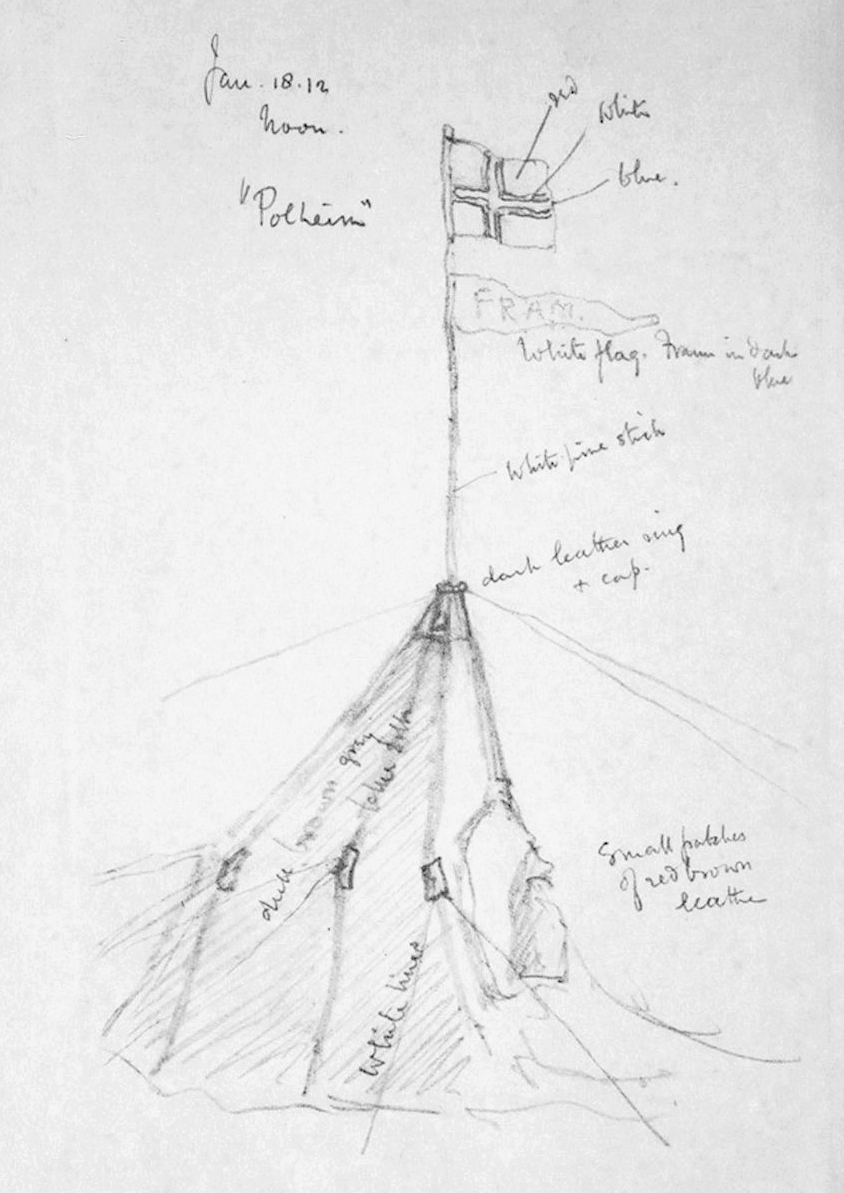
Three hundred and forty miles to the north, at the Pole itself, a tent stood in perfect order. Roald Amundsen had left it there on 14 December 1911. The Norwegian had planted his flag, deposited a letter for the Norwegian king, and taken a photograph of his five-man party with their skis and dogs. The tent contained spare equipment, a sextant, and a message addressed to Scott. Amundsen had known the British were coming. The telegram from Melbourne had seen to that. He had left nothing to chance and nothing to charity; the tent was a statement of completed fact, stocked for survival should his own return journey meet disaster. The fabric was taut. The guy lines were properly tensioned. The snow walls built against the wind were geometrically regular. It waited in the white silence like a theorem already proved.
—-
The plateau had begun on 31 December 1911, when the last supporting party turned back at 87°1′. Scott had watched them go: Teddy Evans, Lashly, Crean, and two seamen. They had hauled the final depot into place—Mount Hooper Depot, named for the man who had packed its contents at Cape Evans—and then embraced the five who would continue. Evans had wept. The separation was absolute. From that point forward, Scott’s party would pull every pound they consumed. There would be no more fresh meat from slaughtered ponies, no more relay work to lighten loads. The five men who remained were Scott himself, Edward Wilson, Henry Bowers, Lawrence Oates, and Edgar Evans. They had started with sixteen. Now they were the polar party.
The first days on the plateau had brought a cruel deception. The surface seemed promising—hard snow that held the sledge runners without the drag of soft powder. Scott noted excellent surface in his journal. The dogs were gone, shot or sent back with earlier parties. The motor sledges had failed at the start. The ponies had died on the glacier. What remained was man-hauling, and man-hauling on a good surface was merely exhausting rather than impossible.
But the plateau had its own method of breaking men. The absence of landmarks meant that every hour resembled every other. The sun circled at the same height, describing a slow ellipse that cast no shadows of direction. The compass needle wandered in the magnetic disturbance of the high polar region. Navigation depended on taking sun sights with a theodolite, a process that required stopping, setting up the instrument, and reading angles in temperatures that froze fingers to metal. Wilson did most of this work, his hands bare for the minutes required to make the observation, then thrust back into mitts while he recorded the numbers.
The sledge meter was their only continuous measure of progress. It clicked over every quarter-mile. Scott recorded its readings obsessively. On good days they made nearly seven miles. On bad days, barely four. The averages mattered. They had calculated their rations for a specific rate of travel. Fall below that rate, and the food would run out before the return to the depots. Push too hard, and the bodies would consume themselves faster than the pemmican could rebuild them.
By 7 January, Scott was writing about a very trying day. The surface had deteriorated. The temperature dropped to −27°F. They made only five and a half miles despite hard pulling. The following day brought better going, eight miles, but the pattern was set. The plateau would not allow a rhythm. Each morning they struck the tent in cold that froze the fabric stiff. Each evening they pitched it in cold that made the task an ordeal of numbed fingers. The sleeping bags, reindeer fur and eiderdown, accumulated frost from their breath until they weighed pounds more than when issued. No one had found a solution to this. Shackleton’s party on the Nimrod expedition had suffered the same accumulation. It was simply part of the cost.
—-
The psychological toll emerged in the journals gradually, like frost forming on a surface. Wilson, the most stoic of the five, wrote of a very long grind and heavy dragging. Bowers, normally exuberant, became terse. On 11 January he recorded only that it was a very heavy march. Oates, whose leg wound from the Boer War had never fully healed, said little in any medium, but his gait began to lag. Scott noted it without comment. Evans, the strongest man physically, showed the first visible strain—his fingers, frostbitten earlier in the journey, cracked and refused to heal.
The sameness itself became the enemy. On the Discovery expedition, Scott had learned that polar travel required breaking time into manageable units: the march to the next meal, the day to the next camp, the week to the next depot. But the plateau offered no natural divisions. There were no pressure ridges to cross, no crevasses to navigate, no change of gradient to mark effort accomplished. The sledge meter clicked, the sun circled, and the snow extended to every horizon in curves that matched the curvature of the earth itself. The men walked inside a featureless sphere.
Scott tried to maintain the apparatus of command. He kept the navigation log, checked Wilson’s observations against his own dead reckoning, decided each morning on the bearing to steer. But the decisions were trivial. South. Always south. The only question was how far they could travel before exhaustion stopped them, and that question answered itself in the sledge meter’s mechanical accumulation.
On 9 January, they passed Shackleton’s farthest south—88°23′. Scott wrote a long entry comparing their situation to his rival’s. Shackleton had turned back with three companions, all of them shattered by the effort, unable to carry sufficient provisions for the return. The comparison was meant to be favorable. Scott had five men, better equipment, more systematic preparation. But the entry betrayed an anxiety. Shackleton had failed because he had calculated his margins too finely. Scott had designed his own expedition to avoid that error. Yet here they were, on the same plateau, subject to the same physics of cold and distance and human limitation.
—-
The final approach began on 16 January. They had marched ten and a half miles, the best day’s run since leaving the glacier. The surface had improved, the temperature moderated to −15°F. Scott allowed himself to believe they were close. He recorded that they were on a good course. The theodolite placed them at 89°32′. The Pole was twenty-eight miles ahead. At their current rate, they would reach it the following day.
But the dead reckoning disagreed. By Scott’s calculation of miles traveled, they should have been farther south than the observation showed. The discrepancy was eight miles—meaning either their speed had been slower than the sledge meter indicated, or the observation was in error, or they were walking in a slight curve without knowing it. In a landscape without features, a curve of one degree over twenty miles would place them miles from their intended target. Scott chose to trust the observation. The theodolite was a precision instrument. The sledge meter might be slipping on its engagement. They adjusted their bearing and marched on.
That night, no one slept well. The tent was crowded with five men, their bodies giving off moisture that froze on the inner wall and fell as ice particles when disturbed. Evans’s frostbitten hands kept him awake; he had taken to wearing mitts constantly now, even inside the sleeping bag. Oates’s old wound throbbed in the cold. Wilson and Bowers lay silent, conserving energy. Scott wrote his journal entry by the light of a candle that burned down too fast, the wax pooling in frozen ridges.
In the morning of 17 January, they struck camp early. The temperature was −22°F. The surface was hard, the wind light from the southeast. They had enough food for four days at full ration, more if they cut to half. The sledge carried geological samples from the Beardmore—thirty pounds of stone that Scott refused to abandon, though every man knew the weight would matter on the return. They harnessed themselves to the traces and began the final march.
The first sign came within two hours. Bowers, whose eyesight was the keenest, spotted something on the bearing ahead. He called a halt. The others strained to see. There was a small elevation in the snow, regular in shape, not a drift formation. They approached it together, still harnessed, the sledge dragging behind.
A cairn stood there. Black stones on white snow, built with deliberate care. On top, a flagstaff bore a flag that was not British.
The flag was black. That was the first detail each man recorded: not the Norwegian colors, but a simple black marker, visible against the snow at distance. The cairn itself was substantial, built of stones that must have been carried for the purpose, since no loose rock existed on the plateau. Someone had taken time and care to make this thing permanent.
They stopped. Scott went forward alone, or perhaps with Wilson—the accounts differ on this point, as they differ on many details of the final hours. The cairn contained a note. Amundsen had left it on 15 December, signed by all five members of his party. It recorded their arrival at the Pole on 14 December 1911. It gave the coordinates: 90° South. It invited Scott to notify the Norwegian king.
The note was dated one month and three days earlier.
—-
The tent was two miles farther on. They found it by following the tracks—ski tracks, still visible, the Norwegians had used skis throughout—leading south from the cairn. The tent was a different model from their own, lighter construction, better adapted to wind. The guy lines were still taut. The snow walls were intact. Inside, they found spare equipment, a sextant, and a letter addressed to Scott personally.
Scott did not describe the letter’s contents in his journal. He recorded only that it existed, that it was addressed to him, that he would deliver it as requested. The omission is significant. Amundsen’s message, whatever its precise wording, would have been courteous, professional, perhaps even sympathetic. The Norwegian had no need for triumphalism; the facts spoke for themselves. But the courtesy would have made the defeat more complete. A gloating enemy could be hated. A respectful one could only be acknowledged.
They photographed themselves at the tent. The camera was heavy, the plates precious, but Scott insisted. The image that survived shows five men in a line, Wilson and Bowers seated in front, Scott, Oates, and Evans standing behind. They wear their full polar kit: reindeer-fur boots, windproof outer garments, goggles pushed up on foreheads. Their faces are not clearly visible at this distance in time, but their posture is. They stand as men stand for a formal portrait, shoulders squared, hands at sides or clasped. There is no celebration in the arrangement. The Norwegian flag, red with blue cross, hangs from the tent pole behind them.
Scott’s journal entry for that evening, written in the tent they pitched beside Amundsen’s, began with the facts and then yielded to something else. He wrote that the worst had happened. He wrote that all the day dreams must go. The phrase day dreams is his own, uncharacteristic, almost childish in its construction. He had carried this expedition for two years—through the fundraising, the ship loading, the winter darkness at Cape Evans, the depot journeys, the glacier ascent—and now the core purpose was revealed as fantasy. Not the Pole itself. The Pole was real, coordinates on a sphere, reached and measured. But the structure of meaning he had built around it, the national achievement, the culmination of naval exploration, the answer to Shackleton, all of this was day dreams. The Norwegians had been there first.
He tried to recover the apparatus of scientific purpose. He wrote that the return would be wearisome, and then, with visible effort, that they were descending in latitude and things would get better. The geological samples were still on the sledge. The meteorological observations could still be completed. The magnetic work, the snow studies, the mapping of the plateau, all remained valid contributions. But the entry could not sustain this tone. It ended with a sentence that has been quoted ever since: Great God! This is an awful place and terrible enough for us to have laboured to it without the reward of priority.
The us is doing heavy work. Scott had led sixteen men south from Cape Evans. Eleven had turned back at appointed places, carrying their own burdens of disappointment. Now five remained, bound together by this failure. The entry does not mention them by name. It does not record their reactions, what they said in the tent that evening, whether they ate together in silence or talked through the night. The journal was Scott’s, but the experience was collective. Each man had his own day dreams to relinquish.
—-
They stayed at the Pole for thirty-two hours. The time was spent in observation and photography, the deliberate work of confirming what they had found. Wilson took magnetic readings. Bowers helped with the theodolite, establishing their precise position. The Norwegians’ tent became a benchmark; they measured its location relative to their own camp. Scott wrote letters, including one to his wife Kathleen that he would never send. The letters were entrusted to the sledges for the return.
On the morning of 18 January, they began the march north. The sledge was lighter by the food consumed, heavier by the geological samples collected. The surface was the same surface they had crossed southward. The sky was the same white void. The sledge meter resumed its mechanical counting.
Scott’s entry for that day began with a calculation. He recorded that they had marched seven and four-tenths miles to the north-northeast. Then he wrote his fear directly: he was afraid the return journey would be dreadfully tiring and monotonous.
The admission was new. On the outward march, even at its hardest, he had maintained the tone of command, the assumption that effort would be rewarded. Now the reward was known to be absent, and the effort remained.
Eight hundred and sixty-two miles lay between them and One Ton Depot, the first substantial cache of supplies. They had food for perhaps three weeks at full ration, longer if they cut.
The plateau would give way to the glacier, the glacier to the barrier ice, the barrier to the coast. Each stage had its own dangers, its own requirements. They had survived them once.
Doing so again, without the sustaining purpose of the Pole, would require a different kind of endurance.
The demoralization was not dramatic. It showed in small things: the reduced mileage, the complaints about frostbite, the silence at meals. Evans’s hands were now seriously damaged, the skin cracked to raw flesh, the fingers swollen. Oates’s wound troubled him more each day; he walked with a visible limp that the soft snow exaggerated. Wilson and Bowers maintained their efficiency, but the exuberance was gone. They were professionals doing necessary work, no longer participants in a great enterprise.
Scott tried to command. He set the pace, chose the camps, maintained the navigation. But the journal entries grew shorter, more factual, as if the interpretive work of leadership had become too costly. On 19 January, he recorded simply that they camped early. On 20 January: heavy dragging. The mileage dropped below six miles per day. The temperature fell to −30°F. The wind, which should have aided them from behind, failed to appear, or blew from the wrong quarter, or brought drift that hid the surface.
The plateau that had been merely featureless became actively hostile. The sledge runners caught on invisible irregularities. The skis, which the Norwegians had used to such effect, were abandoned by most of the party; the technique required energy they could not spare. They walked in harness, leaning into the traces, the sledge resisting each pull. The sledge meter continued to turn, but the miles came harder.
—-
The question of why they failed to reach the Pole first has been answered many times. Amundsen had dogs, and knew how to use them. He had skiers, trained from childhood. He had planned for a single objective, where Scott had balanced exploration against science against national prestige. He had started earlier, moved faster, carried less, turned back sooner from his final depot. The comparison is mechanical, almost insulting in its simplicity, but it accounts for the thirty-three days that separated the two arrivals.
What the comparison does not account for is the psychological cost of arriving second. Scott’s party did not die at the Pole. They died on the return, eleven miles from One Ton Depot, in circumstances that have been disputed ever since. But the return began in defeat. Each step northward was a step away from the purpose that had justified the effort. The geological samples, the meteorological records, the magnetic observations—these were real achievements, recognized by scientists then and since. But they were not what the men had marched for. The day dreams had sustained them through the glacier, through the plateau, through the final approach. Without them, the body had to find reasons to continue that the mind could not supply.
The fragility was not in the equipment or the planning alone. It was in the connection between purpose and effort, the belief that the effort would be worth something. Amundsen’s tent, with its tidy geometry and its black flag, had severed that connection. The Norwegians had arrived first, and they had arrived completely, with dogs and skis and surplus energy, in time to build a proper cairn and leave a stocked shelter. Their success was visible in every detail of the scene. Scott’s party, arriving exhausted, carrying their own exhaustion with them, could only register the contrast.
They turned north on 19 January. The deflated party began the 862-mile return journey. Scott’s prediction would prove exact: the journey was dreadfully tiring and monotonous. But the dread was deeper than tiredness. It was the dread of effort without meaning, of survival without victory, of walking eight hundred miles to confirm what a single photograph had already established.
On 24 January, they reached the head of the Beardmore Glacier. The descent would be faster than the ascent, but more dangerous. Crevasses that had been visible in summer snow would be hidden by drift. The cold would intensify as they lost elevation. The ponies were gone, the dogs were gone, the supporting parties were gone. There was no one ahead to prepare the way, no one behind to follow. The five men roped themselves together and began the descent, carrying their failure with the same harness that carried their sledge.
Evans’s hands were now useless for fine work. He could not help with the tent, could not prepare food, could barely manage his own clothing. Oates could no longer pull with his full strength; he leaned into the traces but the power had gone from his left leg. Wilson and Bowers maintained their routines, but the routines had become mechanical, stripped of the improvisation that hope makes possible. Scott led, or tried to lead, but leadership requires a destination that matters, and the only destination now was survival itself—a purpose too thin to bear the weight of what they carried.
The glacier took them down. The sledge meter turned. The miles accumulated backward, each one a small subtraction from the distance that still remained, each one an addition to the burden that would have to be carried again. They had been here before, on this same ice, in this same cold.
But they had been different men then, marching toward something. Now they marched away, and the difference was structural, not merely directional. The expedition had been built around an assumption of success, and the assumption had collapsed. What remained was a physical problem: how to move five weakened bodies and one overloaded sledge across eight hundred miles of ice before the food ran out. The problem was soluble in theory. In practice, it would require resources that the party no longer possessed, calories and warmth and the will to deploy them efficiently, day after day, without the reward that had justified the expenditure.
They camped on the evening of 24 January at the glacier’s head. The temperature was −25°F. The wind was rising. In the tent, the five men arranged themselves in the positions they would occupy for the next sixty days: Scott and Wilson on one side, Bowers and Oates on the other, Evans in the middle, his damaged hands wrapped in rags. They ate their pemmican in silence, or near silence, the only sounds the clicking of the primus stove and the wind against the canvas. Outside, the Norwegian tent stood empty at the Pole, its flag still flying, its message delivered. The British tent held five men who had received that message and were now required to live with it, step by step, mile by mile, until the ice decided whether they would survive to carry their failure home.