Chapter 9
The Refuge at the Garrett Farm
The wagon jolted over a rut in the Virginia road, and Booth’s frame, wedged between sacks of corn and a rusted plow share, absorbed the shock without sound. Herold, walking beside the cart, heard only the creak of wheels and the labor of the mule.
They had crossed the Potomac finally on the night of April 22, guided by Confederate signal lights that flickered and died against the black water, and now, on the afternoon of the twenty-third, they were being conveyed toward a refuge that neither man had secured for himself.
Their guide was a young Confederate veteran named William S. “Willie” Jett, a former private in the 9th Virginia Cavalry, who knew the roads and the temper of Caroline County and who had agreed to lead them to a farmhouse where wounded soldiers were sometimes sheltered. What Jett did not know, or claimed not to know, was the true identity of the man who called himself James W. Boyd.
The alias entered the record here, and it would cling to Booth through his final days. To Richard H. Garrett, the sixty-year-old farmer who opened his door that evening, the stranger presented himself as a Confederate soldier wounded in the fighting near Petersburg. The leg was proof enough—swollen beneath Dr. Mudd’s splint, discolored, clearly in need of rest—and the younger man with him played the part of a comrade who had helped his friend escape the collapsing lines.
Garrett was a widower, living with several sons and daughters in a frame house surrounded by outbuildings, tobacco barns, and the cultivated fields of a county that had supplied the Confederacy with men and materiel through four years of attrition. The farm was not wealthy, but it was orderly, and the Garretts had maintained through the war a posture of Confederate loyalty that did not require asking too many questions of men in need.
The hospitality was extended on terms that suited both parties. Booth needed a horizontal surface and time to recover his strength before pressing south toward the Confederate forces that he still believed were gathering in Texas or the Trans-Mississippi. Garrett needed reassurance that his guests were what they claimed to be—officers of the dying cause, entitled to the shelter that Virginia tradition demanded. The transaction was sealed with the alias, with Booth’s theatrical bearing, with Herold’s plausible chatter about regiments and battles. Richard Garrett would later testify that he had no suspicion of their true identities until Union cavalry arrived at his door; his family was unaware of Lincoln’s assassination. Whether this was prudence after the fact or genuine ignorance, the record cannot resolve.
What remains certain is that on the night of April 23, John Wilkes Booth slept under a Virginia roof for the first time since his flight began, and that the roof belonged to a family whose willingness to harbor strangers was about to be tested against the advancing reality of Union victory.
The house itself was cramped for unexpected guests. Booth was placed in a room with one of the Garrett sons, while Herold made do with the others. The arrangement was meant to be temporary—a night or two of rest, then onward movement. But Booth’s leg would not permit movement. The swelling had reached his boot, and when he finally removed it, the flesh adhered to the leather and tore. Herold, who had worked in a Washington pharmacy, applied what politices he could improvise from the farm’s limited stores, but the wound was beyond amateur care. Booth lay in the Garrett house through April 24, and then through the night of the twenty-fourth, and then through the twenty-fifth, each day of delay multiplying the risk that his hosts would recognize the face that stared from War Department reward notices.
The notices had preceded him. Secretary of War Edwin Stanton’s $50, 000 proclamation, issued on April 20, had been printed in Washington newspapers and distributed as handbills through Maryland and into Virginia. The description was specific: a man of five feet seven or eight inches, slender build, high forehead, black hair, heavy black mustache. The reward for Herold was $25, 000, and lesser sums were offered for John Surratt and for the man still unknown who had attacked Secretary Seward. The notices reached Port Royal, the nearest town of any size to the Garrett farm, and they reached the Confederate veterans who drifted through the region in the war’s final dissolution.
Yet the notices did not reach Richard Garrett, or if they reached him, they did not prompt the connection that hindsight makes inevitable. The man in his house was wounded, proud, secretive. He read newspapers with an intensity that seemed excessive for a common soldier. He refused, when pressed, to give the name of his regiment or the location of his service. These were marks of something other than ordinary wounded honor, but they were not conclusive, and in April 1865, conclusiveness was in short supply.
What the Garretts observed, and what their testimony would later establish, was a guest whose demands escalated with his confinement. Booth wanted privacy, then he wanted company, then he wanted the use of the farm’s horses for an unspecified departure. He wanted to sleep in the tobacco barn rather than the house—a request that Richard Garrett granted with evident reluctance. The barn was a substantial structure, used for curing the leaf that was the farm’s cash crop, and it offered Booth the isolation he craved and the security he imagined. He could see approaches from its loft. He could defend its single entrance, if defense became necessary. He could pretend, in its dim interior, that he was still a military man making tactical dispositions rather than a fugitive whose options had narrowed to a single county, a single farm, a single outbuilding.
Herold remained in the house, and this separation—Booth in the barn, Herold with the family—created the conditions for divergent fates. The younger man was sociable, helpful, willing to join the Garrett sons in their evening routines. He played with the children, spoke familiarly of Washington, accepted the farm’s simple meals without complaint. Booth, by contrast, grew more isolated and more imperious. He sent Herold with messages. He demanded that food be brought to the barn. He spoke of papers he carried, papers that would justify his actions and vindicate his name, though he showed these papers to no one. The performance of Boyd was becoming unsustainable, and both men knew it.
The collapse of Confederate authority in Virginia accelerated their exposure. On April 24, the same day that Booth and Herold arrived at the Garrett farm, General Robert E. Lee was meeting with General Ulysses S. Grant at Appomattox Court House to arrange the surrender terms that would end the Army of Northern Virginia. The news traveled slowly through a landscape without telegraph lines and with few reliable couriers, but it traveled inexorably. By April 25, Union patrols were moving through Caroline County, and Confederate soldiers who had not yet heard of the surrender were learning of it from the blue uniforms that appeared on roads they had considered safe. The war was over. The cause for which Booth had killed Lincoln was dissolved. The sanctuary he had sought in Virginia was dissolving with it.
This was the erosion of Confederate loyalty in its most concrete form: the willingness of sympathizers to risk their safety for wounded strangers, measured against their growing recognition that the Confederacy no longer existed to reward such risks. Richard Garrett had extended hospitality to “Boyd” on the assumption that the Confederate chain of command still functioned, that wounded officers would be reclaimed by their units, that the social order of wartime Virginia would persist into whatever negotiations lay ahead. By April 25, this assumption was becoming untenable. Union cavalry had been seen near Port Royal. The roads were no longer secure for men without papers. And the wounded officer in the tobacco barn was behaving less like a soldier awaiting reunion with his command than like a man hiding from something he would not name.
The manhunt that would find him had meanwhile undergone its own transformation. Stanton, operating from the War Department telegraph office, had converted the search for Lincoln’s assassin from a police investigation into a military operation. The key instrument of this conversion was Lafayette Baker, the detective who had built a network of informants throughout the occupied South, and Baker’s chosen instrument was Lieutenant Colonel Everton Conger. Following the assassination of President Lincoln on April 14, 1865, Conger was ordered to accompany a detachment of 25 Union soldiers from the 16th New York Cavalry Regiment, led by Lieutenant Edward P. Doherty. The soldiers pursued Booth through Southern Maryland and across the Potomac, guided by intelligence that Baker’s agents extracted from Confederate prisoners, displaced civilians, and the rivermen who had witnessed the fugitives’ passage.
The detachment that finally crossed into Virginia represented a new order of pursuit. These were not Pinkerton detectives or Washington police; they were mounted cavalry, armed and provisioned for extended operation, carrying warrants that authorized them to arrest or kill. Among them was Sergeant Boston Corbett, a figure whose presence in the record would acquire retrospective significance.
Thomas H. “Boston” Corbett was an American soldier and milliner who, on April 26, 1865, would kill John Wilkes Booth, the assassin of President Abraham Lincoln. Known for his devout religious beliefs and eccentric behavior, Corbett had been a milliner in New York before the war, had castrated himself with scissors to resist temptation, and had survived imprisonment at Andersonville to emerge as a soldier of ferocious, unorthodox piety.
Despite his religious-oriented eccentricities, Corbett reportedly was a good soldier. On June 24, 1864, after Confederate States Army troops led by John S. Mosby in Culpeper, Virginia had captured a good number of Corbett’s comrades, Corbett continued to fire his weapon despite orders to retreat. His commander, Lieutenant Colonel Everton Conger, would later describe him as reliable in action, if unpredictable in conversation.
The cavalry detachment moved by steamboat down the Potomac, then by forced march across the Northern Neck of Virginia. Their guide, when they found one, was Willie Jett—the same young Confederate officer who had led Booth and Herold to the Garrett farm. Jett had been captured near Port Royal on April 25, interrogated by Conger, and persuaded to reveal the location of the wounded “Boyd.” The persuasion was not gentle. Conger was an intelligence officer of the Baker school, trained to extract information through methods that left no documentary record, and Jett was a Confederate in a landscape where Confederate credentials had become liabilities. He led the cavalry toward the Garrett farm on the night of April 25, riding ahead of the main body to avoid alerting his former charges.
The convergence was now set in motion. Booth in the tobacco barn, Herold in the house, the Garrett family suspended between hospitality and suspicion, and Union cavalry moving through the darkness with specific intelligence of their destination. Richard Garrett’s son John would later describe the growing unease in the household, the whispered conferences about their guests’ true identities, the decision to remove the horses from the barn so that “Boyd” could not depart with them. Booth had asked for the horses on the evening of April 25, and the Garretts had refused him, citing the risk of Union patrols. The refusal marked the end of hospitality and the beginning of confinement. Booth was no longer a guest to be sheltered; he was a liability to be contained until the family’s own position could be secured.
Herold sensed the shift before Booth did. On the morning of April 26, he left the house and approached the tobacco barn with word that strangers had been seen on the road. Booth’s response was to prepare for confrontation—to load the weapons he still possessed, to position himself in the barn’s loft, to refuse Herold’s suggestion that they flee together into the woods. The leg would not carry him far, and he knew it. What remained was the theatrical exit that his entire career had prepared: a stand against overwhelming force, a final declaration of principle, a death that would be remembered as martyrdom rather than capture.
The Garretts watched this preparation with the particular horror of civilians who have been drawn into events they do not control. Richard Garrett had offered shelter in the name of a cause that no longer existed. His sons had complied with their father’s wishes, then had begun to protect themselves against their father’s error. The farm was not a fortress. It was a working property, visible from the road, known to neighbors, impossible to defend against mounted cavalry. The Garretts had not chosen to become participants in the manhunt; they had been conscripted by Booth’s arrival and were now being conscripted again by his refusal to leave.
The external pressure that would break this stalemate was already in motion. A detachment of 26 Union soldiers from the 16th New York Cavalry Regiment to capture Booth in Virginia, accompanied by Lieutenant Colonel Everton Conger, an intelligence officer assigned by Lafayette Baker, had reached the vicinity of the farm by midnight on April 25. The detachment had steamed 70 miles down the Potomac to Belle Plain, then marched through the darkness with the particular urgency of men who had been misled before. Booth had escaped multiple cordons, had vanished from under the noses of pursuers who had every advantage of resources and numbers. The 16th New York Cavalry was not inclined to repeat these errors. They surrounded the farm before dawn, established positions covering all exits, and sent forward a party under Conger’s direct command to demand surrender.
What followed would be disputed in testimony, in newspaper accounts, in the official reports that Stanton required. The essential facts are these: Herold emerged from the tobacco barn and surrendered without resistance. Booth remained inside, refusing to come out, engaging in a verbal exchange with the Union officers that lasted approximately one hour. The barn was set on fire, whether by Booth’s own hand or by the cavalry’s initiative remains unclear. And in the flames and smoke, Boston Corbett fired the shot that killed John Wilkes Booth, piercing his neck and severing his spinal cord.
But this climax belongs to the next movement. The present chapter must close on the threshold, on the moment before the fire and the shot, when the convergence was complete but its consequences not yet realized. The Garrett farm had become the terminal point of Booth’s flight not through any design of his own, but through the exhaustion of alternatives. He had crossed the Navy Yard Bridge, had stopped at the Surratt tavern, had been treated by Dr. Mudd, had hidden with Thomas Jones, had twice attempted the Potomac, and had finally reached Virginia only to find that Virginia offered no sanctuary that the Union cavalry could not penetrate.
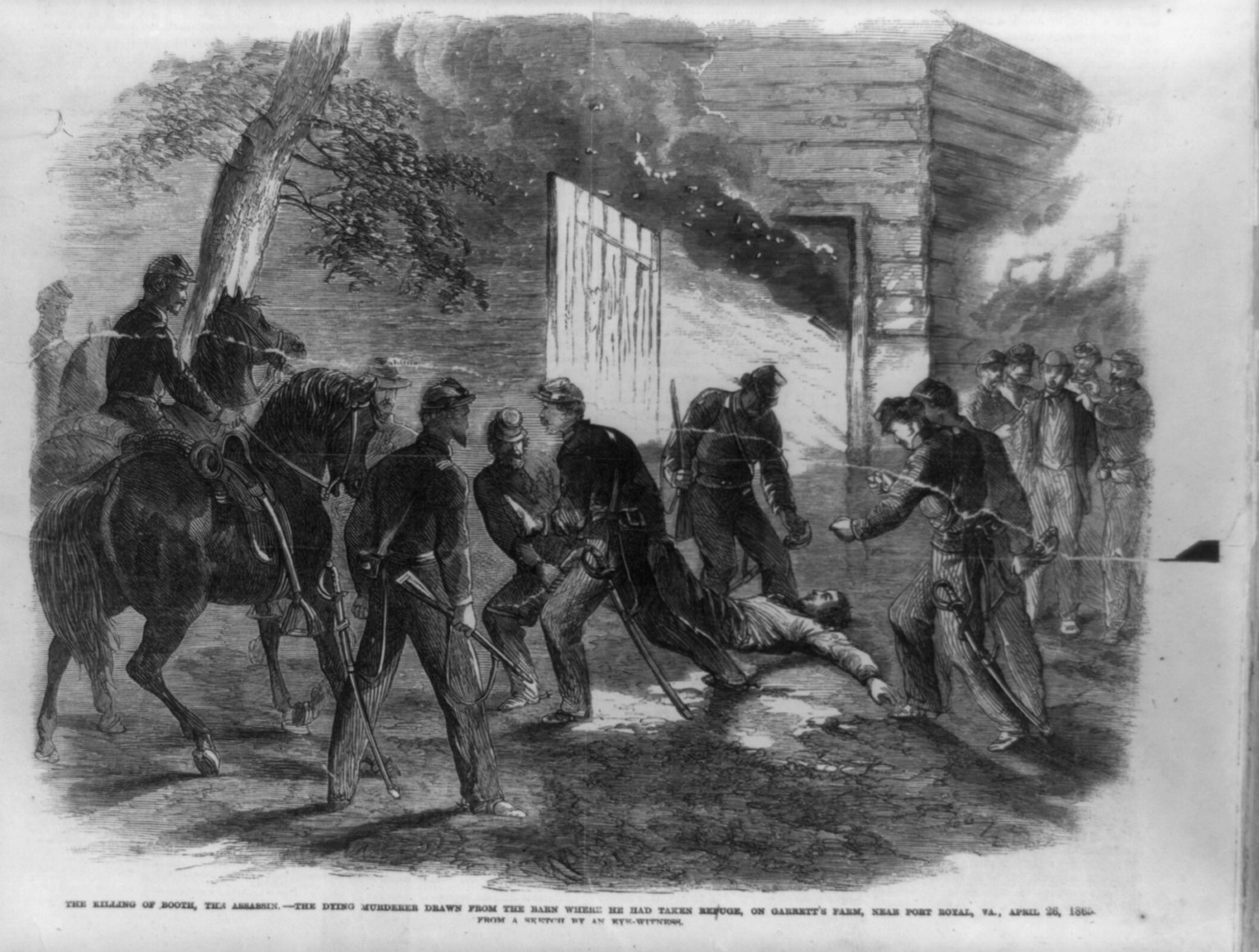
The institutional machinery that found him was, in retrospect, formidable. Stanton’s War Department had mobilized military resources on a scale that no fugitive could outrun indefinitely. Baker’s intelligence network had penetrated the Confederate underground that Booth had counted upon for support. And the specific intelligence provided by Willie Jett—extracted under pressure, purchased with promises or threats—had reduced the search from a regional manhunt to a single farm, a single barn, a single wounded man with a loaded pistol and a collapsing sense of his own heroic narrative.
Union cavalry, guided by specific intelligence from Willie Jett, had pinpointed the Rappahannock region; the hunt was now converging irrevocably on the Garrett farm.